Grid fees 2026
are falling — what it means for you
A federal subsidy of €6.5 billion cuts transmission grid fees nationwide by roughly 17 percent in 2026. A household using 3,500 kWh saves about €75 to €100 a year. Add a tariff switch and reach up to €850 in savings.
By Checkalle Editorial · Updated May 16, 2026
Key takeaways
- ●Bundestag decision, December 22, 2025: €6.5B subsidy for transmission grid fees in 2026.
- ●Average reduction in electricity grid fees: approximately 17 percent.
- ●Biggest relief in Mecklenburg-Western Pomerania (~−29%) and Brandenburg (~−22%); smallest in North Rhine-Westphalia (~−2%).
- ●Distribution grid fees (local) are not subsidized and stay roughly flat.
- ●Consumer warning: Fixed-price contracts see the cut only at renewal.
- ●The subsidy covers 2026 only; 2027 continuation is uncertain.
Claim the subsidy and save even more
Compare electricity rates for your postcode — free, in under two minutes
How much will you save in your state?
Estimated values for a household using 3,500 kWh annually. Based on preliminary 2026 grid fee determinations from Stromauskunft.de and Strom-Report.com.
| State | Grid operator | 2026 reduction | Annual savings |
|---|---|---|---|
| Mecklenburg-Western Pomerania | E.DIS / WEMAG | ~ −29 % | €105–111 |
| Brandenburg | E.DIS / EWE Netz | ~ −22 % | €80–95 |
| Schleswig-Holstein | SH Netz | ~ −18 % | €70–85 |
| Lower Saxony | Avacon / EWE Netz | ~ −15 % | €60–75 |
| Saxony | MITNETZ STROM | ~ −12 % | €50–65 |
| Hesse | Syna / EnBW | ~ −7 % | €30–45 |
| Bavaria | Bayernwerk | ~ −5 % | €25–35 |
| North Rhine-Westphalia | Westnetz | ~ −2 % | €10–20 |
Transmission grid vs. distribution grid: where the subsidy works
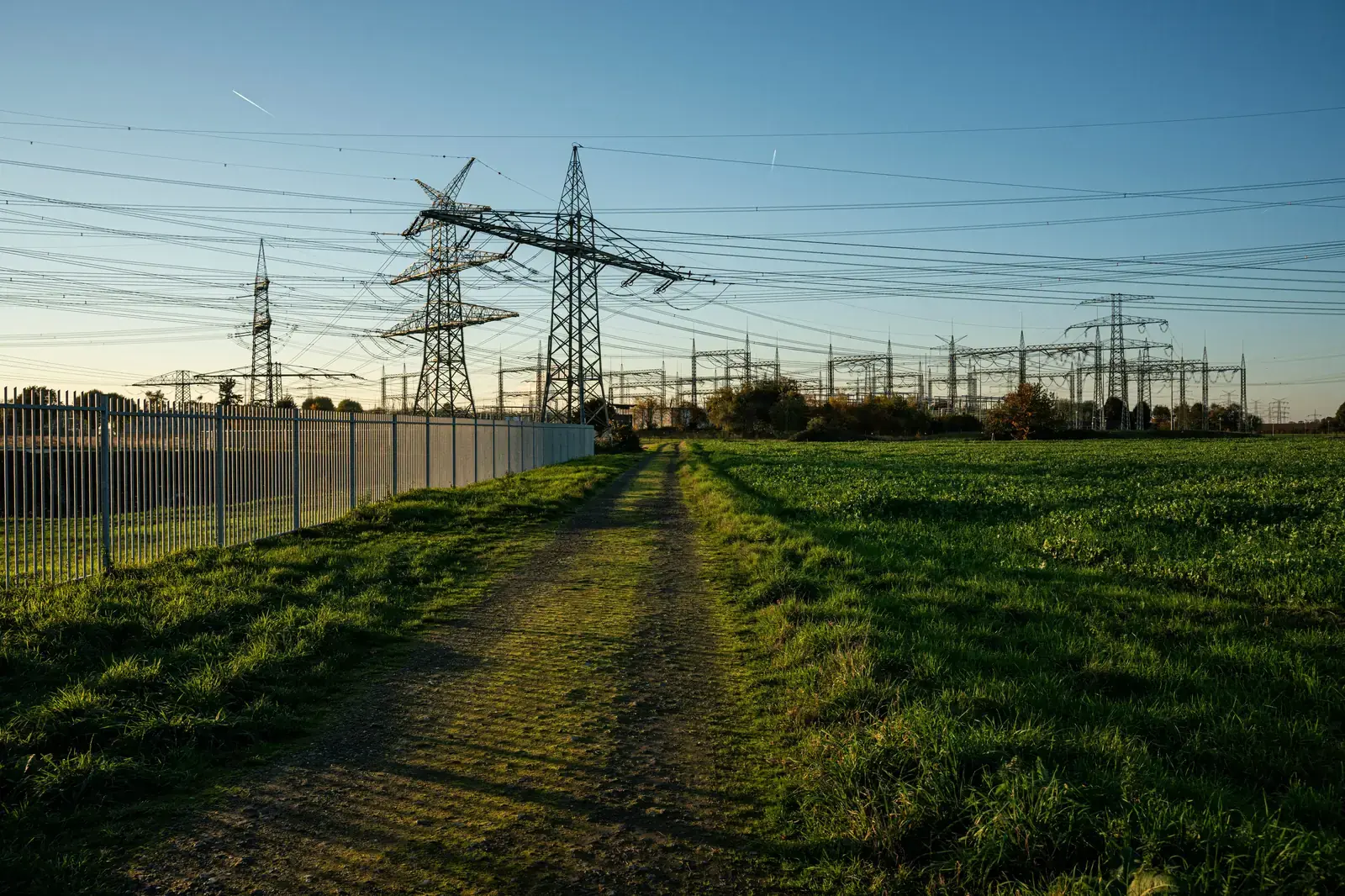
Electricity reaches you in two stages: first through the transmission grid (high voltage, 220/380 kV) operated by four companies — 50Hertz, Amprion, TenneT, and TransnetBW — then through the regional distribution network to your plug. Only the first stage gets the 2026 subsidy.
Transmission grid (with subsidy)
Distribution grid (no subsidy)
Your personal relief depends on transmission fees as a percentage of your regional bill. Rural, wind-heavy states benefit most. Dense city grids benefit less.
What makes up your 2026 electricity bill
Typical breakdown per BDEW data for 2026. The federal subsidy targets grid fees specifically.
Grid fees 2026: about 24 percent
The second-largest slice after energy sourcing — and exactly where the federal subsidy cuts costs in 2026.
The national number: 10.4 ct/kWh gross
Bundesnetzagentur monitoring data puts the combined 2026 grid fee (transmission plus distribution) at roughly 10.4 ct/kWh gross nationwide — about 20 percent below 2024. Household-level cuts range from 12.9 to 17.6 percent depending on operator. For a household using 4,000 kWh a year, that is about 1.88 ct/kWh less, or roughly €75 saved from the grid-fee cut alone — before any tariff switch. Relief is steepest in eastern Germany: the E.DIS network (Mecklenburg-Western Pomerania/Brandenburg) falls about 29.3 percent, the Avacon network (Saxony-Anhalt/Lower Saxony) about 26.8 percent.
Section 14a EnWG: variable grid fees for EVs and heat pumps
Owners of heat pumps, EV chargers, or home batteries have had access to special variable-rate grid fees since 2024 under Section 14a of the Energy Act. The deal: your grid operator can briefly reduce power during peak times. In exchange, you get a discount on grid fees — either a flat cut or time-of-use pricing where overnight and weekends cost less.
You need a smart meter. Planning an EV or heat pump purchase? Filter tariffs explicitly for Section 14a options. Read more in the article on negative electricity prices and Section 14a EnWG.
Consumer protection note
The subsidy sounds good, but it does not reach everyone immediately. Providers must pass on lower grid fees, but fixed-price contracts typically see the cut only at contract renewal. Check your January 2026 electricity statement to confirm the reduced grid charge is applied.
Still, act to save: switching tariffs pays off in 2026
Grid fees are the same for all suppliers — you cannot escape them. Energy sourcing is different: switching from basic supply to a competitive tariff often saves 700 to 900 euros per year for a four-person household. Combine the grid fee relief with a tariff switch and pocket the maximum savings.
- Find your annual kWh from your last bill.
- Enter your postcode and compare offers.
- Pick a tariff with reasonable terms (12 months, max 6 weeks notice to cancel).
- Switch online — the new company handles canceling the old one.
Use the electricity calculator for exact numbers. Learn more about 2026 electricity prices and the electricity price brake. For thoughts on what happens when the subsidy runs out, see the electricity price forecast 2026.
Frequently asked questions about 2026 grid fees
Are grid fees rising or falling in 2026?
Transmission fees are dropping in 2026 because the German federal government is providing a €6.5 billion subsidy. Distribution fees (local level) are not subsidized and remain mostly stable or slightly up in some regions. Overall, most households benefit from lower bills.
Who gets to claim the €6.5 billion federal subsidy?
All electricity customers in Germany — households, businesses, and industry. How much you save depends on your local grid operator and your contract terms. If you're on a fixed-price tariff, the reduction typically applies only when that contract ends.
When were the 2026 grid fees announced?
The preliminary rates were set in October 2025 by transmission operators. The Federal Network Agency (BNetzA) approved the final figures. All electricity providers must apply the new rates starting January 1, 2026.
What percentage of my electricity bill is the grid fee?
About 24 percent according to BDEW data for 2026. On a typical electricity price of 35 ct/kWh, that's roughly 8.4 ct/kWh. Regionally, the range is 7 ct/kWh in cities to 13 ct/kWh in areas with heavy renewable expansion.
Why do grid fees vary by region?
Each regional grid operator calculates costs for maintenance, infrastructure upgrades, and connecting renewable energy plants separately. Rural areas with lots of wind farms have higher per-customer costs than dense cities with efficient grids — so they see bigger relief in 2026.
Can I avoid grid fees by switching electricity providers?
No. Grid fees go to your local operator and are identical regardless of supplier. You only save on the energy component and the provider's margin. Switching from basic supply typically saves 200 to 900 euros per year on these parts alone.
What are variable grid fees under Section 14a EnWG?
A special program for households with heat pumps, EV chargers, or home batteries. The grid operator may briefly reduce power during peak times; in exchange, you get a discount on grid fees — either a flat reduction or time-of-use pricing with cheaper rates at night and weekends. Requires a smart meter.
Will the federal subsidy continue in 2027?
The Bundestag decision from December 22, 2025 applies only to 2026. Whether it extends to 2027 depends on the federal budget that year. Continuity is not guaranteed — those switching now can lock in the benefit for their contract term.
Sources and further reading
- German Federal Government — Lower grid fees for 2026 (decision Dec. 22, 2025)
- Federal Network Agency — 2026 grid cost distribution
- BDEW — How the grid fee subsidy affects electricity customers
- Strom-Report — Grid fees 2026 (national average and regional breakdown)
This page is not professional advice. Figures come from preliminary 2026 grid fee determinations and BDEW/consumer agency data as of May 2026. Actual household savings depend on consumption, contract, and operator.